 1900 2039
  p.dbcl@ntt.edu.vn


From March 31 to April 3, 2026, at Can Tho University, the ACCEES Project (Advancing the Digital Technology Ecosystem in Higher Education in Vietnam) officially concluded its first year of implementation with two consecutive events: the Project Executive Board Meeting, which approved all Year 1 deliverables and agreed on the 2026 implementation roadmap, followed by a three-day intensive training workshop that resulted in the development of four digital competency training modules for lecturers and university staff in Vietnam. These modules will serve as the foundation for training core university personnel in the next phase of the project.
The NTTU delegation, led by Dr. Phan Thi Viet Nam, Vice Rector and Head of the University’s ACCEES Project Executive Board, participated throughout the entire series of activities.
Successful Completion of the First Year: Deliverables Approved and 2026 Roadmap Finalized
On March 31, 2026, the Year 2 Project Executive Board Meeting was held in a hybrid format, with participation from representatives of Vietnamese member universities and European partners from France, Belgium, and Greece.
The Executive Board officially approved all Year 1 project deliverables for submission to the European Union project management platform, including:
- a consultancy report on the digital technology ecosystem in Vietnamese higher education;
- a development plan for Open Educational Resources (OER) aligned with international standards;
- a student digital competency development plan based on the European DigComp 2.2 Framework and aligned with Vietnam’s national standards; and
- a digital competency development plan for lecturers and support staff, structured across three competency levels.
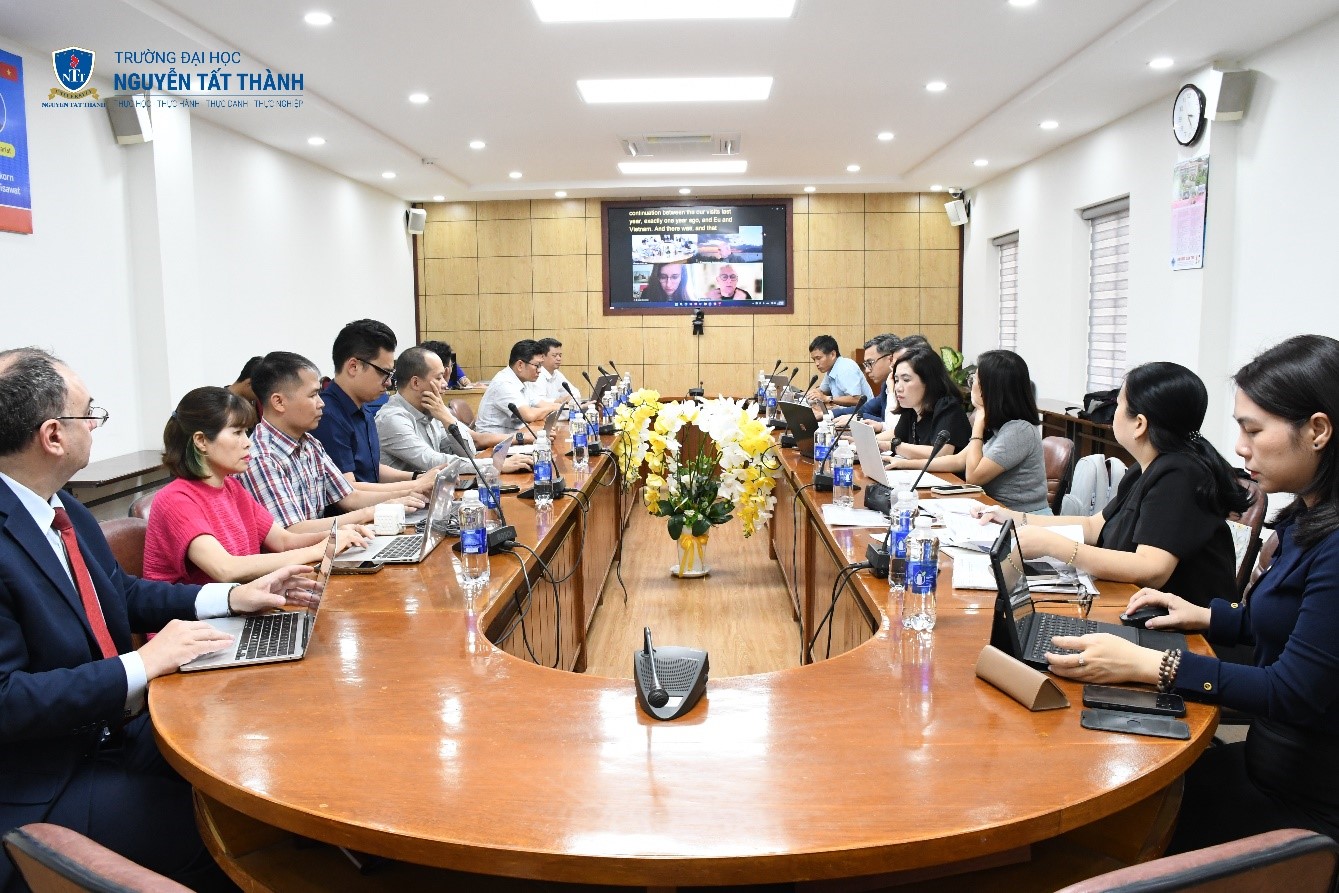
Regarding the 2026 implementation roadmap, the Executive Board agreed that:
- five digital learning spaces will be inaugurated at the five member universities before September 2026;
- a workshop to develop student training modules will be held in October 2026; and
- the first Training-of-Trainers (ToT) program for core university personnel will be organized at the University of Danang at the end of the year.
For NTTU, the University will continue to play a leading role in the project’s overall communication activities. In 2025, project communications reached more than 20,000 people, while the target for 2026 has been set at one million.
Three-Day Workshop Produces Four Digital Competency Training Modules
From April 1–3, 2026, approximately 25–30 representatives from ACCEES member universities participated in an intensive three-day workshop facilitated by educational experts from the Institute for Development and Innovation in Pedagogy (IDIP), University of Strasbourg.
Rather than focusing solely on theory, the workshop adopted a practice-oriented approach. During the morning of the first day, participants were introduced to modern instructional design principles, including:
- constructive alignment;
- developing measurable learning outcomes using Bloom’s Taxonomy; and
- the ICAP Framework for classifying levels of learners’ cognitive engagement.
In the afternoon, participants voted to select four out of five proposed training modules for immediate development during the remaining two days.
During the subsequent group-working sessions, each team progressively:
- developed a competency map;
- formulated learning outcomes;
- designed teaching and learning activities;
- selected appropriate digital tools; and
- established suitable assessment methods.
On the afternoon of April 3, experts from the University of Strasbourg joined via Zoom to review each group’s work, focusing on the constructive alignment among learning outcomes, learning activities, assessment methods, and digital tools before formally approving the modules.
The four approved training modules are:
- Designing and Producing Digital Learning Resources;
- Designing Learning Activities Based on Active Pedagogy;
- Designing Progressive Learning Assessment Systems; and
- Designing Online Courses.
These four modules not only provide practical tools for digital teaching but also contribute to transforming instructional design toward a learner-centered approach in the context of digital transformation.
Departmnet of Qulaity Assurance
